












Bitcoin Found Its Floor. Now It’s Hunting for a Ceiling.
On April 7, I flagged a subtle shift in Bitcoin. It was absorbing bad news without breaking down. Support near $66,000 kept holding, technical pressure was easing, and the risk-reward was beginning to favor a bounce rather than another leg lower. Not a full green light, but getting long against the upper $60,000 range made sense as the edge had clearly shifted away from pressing shorts.
Fast forward two weeks, and that shift has played out nicely. Buyers stepped up once technicals supported their actions, and they began bidding against the short-term 8-day exponential moving average (EMA) and pushing price higher.
Looking at the past two weeks, three things stand out.
First, price never broke $66,000. It didn’t even test it after April 7. Traders had a narrow window to buy in the upper $60,000s before BTC was bid back into the low $70,000s. That’s not what a weak market looks like.
Second, the technical backdrop has flipped. On April 7, the 8-day EMA was still below the 21-day EMA, and price was barely holding above the 50-day simple moving average (SMA). Today, those same levels are working in the bulls’ favor. With short- and intermediate-term trend now aligned, dips are likely to get bought, at least in the near term.
Third, as always, once price starts working, the narratives follow. You’re now hearing that MicroStrategy’s (MSTR) ongoing buying is supporting the market, alongside improved headlines out of Iran and renewed focus on the Fed. But MicroStrategy was buying the entire way down, including when the chart looked terrible, and Bitcoin was printing lower lows every other day. Nobody cared then. And that’s all well and good, but it misses the point.
Bitcoin didn’t rally because of a headline. It rallied because price dropped to a level that cut off selling. Once supply was exhausted and selling was cut off beneath $66,000, price only had one direction to go. The repeated tails at that level, combined with the shift in short-term moving averages, were the tell that control was shifting.
For bulls, that means the path of least resistance remains higher in the very near term, with one and two-day dips likely to be bought. But with the 200-day SMA trending lower and soon to intersect price, this is definitely not an area to get complacent with longs.
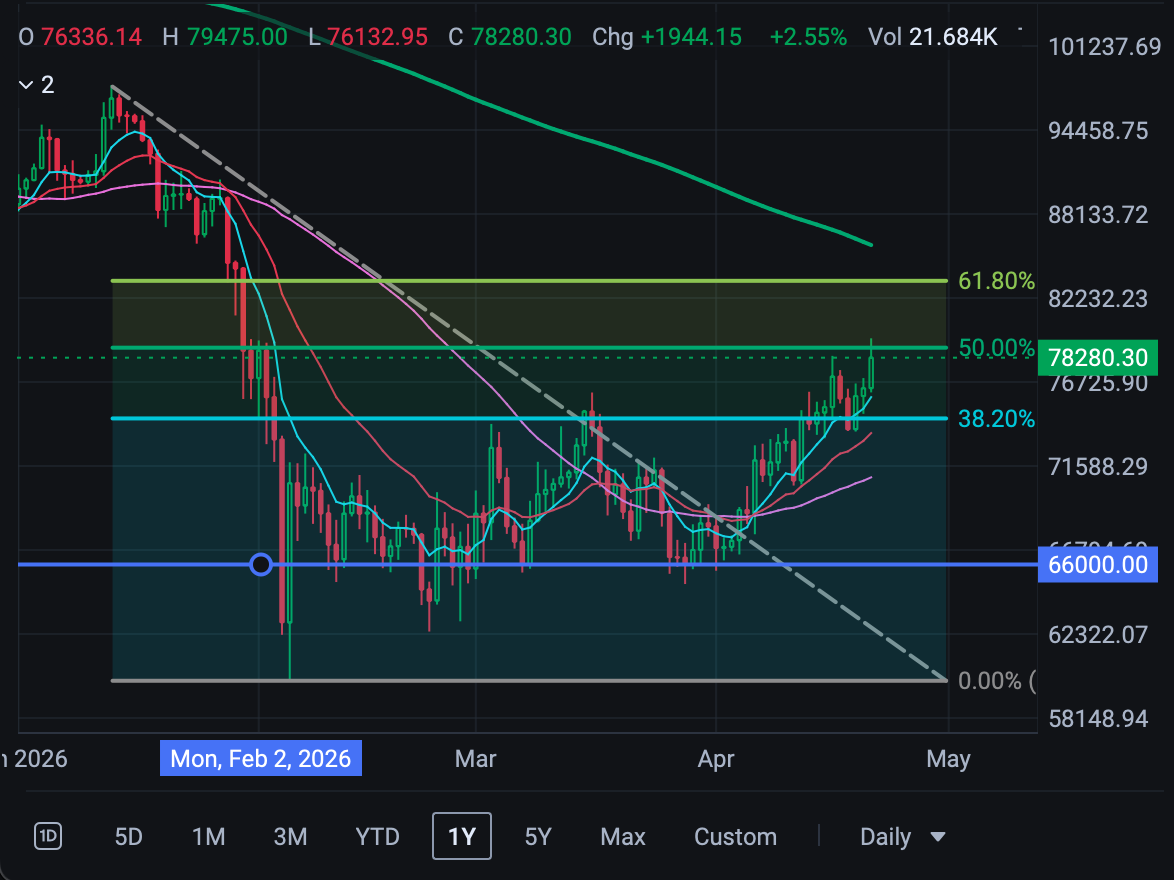
With BTC now trading near the midpoint of the January–February decline, some early dip buyers will start taking profits. But the more important area sits just overhead. The 61.8% retracement and the declining 200-day SMA are converging in the $83,500 to $85,500 range. That’s where I’d expect sellers to show up in a more meaningful way. And where a more neutral trading posture makes sense.
For now, the strategy stays the same. Buy dips against the 8-day and 21-day EMAs and sell into strength on short-term extensions. But as we push into the mid-$80,000s, the posture should shift. Traders who got long in the $60,000s should start thinking less about pressing longs and more about managing risk as the market looks to build its next base.
Related: This Publicly Traded MLB Team Is Crushing It on the Field — and in the Market
At the time of publication, Byrne was long IBIT and BTC
Content Original Link:
" target="_blank">


