







U.S. Navy Remains Poised in the Arabian Sea
An unexpected release of up-to-date Sentinel-2 satellite imagery covering the Arabian Sea and CENTCOM area on May 6 and 7 has enabled analysts to gain a better understanding of how the U.S. Navy is operating its blockade of the Strait of Hormuz and positioning itself against the threat posed by Iran’s IRGC Navy. Since February 28, access to commercial satellite imagery has often been time-lagged or restricted in coverage, but the recent release has enabled open-source analysts, led by the doyenne of the community MT Anderson, to draw some useful deductions.
In recent days, the U.S. Navy has sent Arleigh Burke destroyers, and probably other craft as well, through the Strait of Hormuz and then back out again, indicating that the 6th Fleet has confidence to counter the IRGC Navy’s threat, at least for short periods of time and when it wants to. This suggests that the U.S. Navy's defensive shield against drones and cruise missiles, as well as underwater threats, remains intact. But it also implies that the U.S. Navy has a good understanding of where mines might be, or has the means to clear a mine-free path when it chooses to do so. On balance, given that a number of ships have also made solo runs through the southern half of the Strait in recent days, it appears that very few, if any, mines have been laid. The Royal Navy of Oman also does not appear to hesitate before moving through these waters to come to the aid of ships in distress.
U.S. Navy ships do not linger in the Strait, and a number of merchant vessels have been hit by the IRGC Navy in recent days, which implies that the IRGC Navy still has a credible anti-ship capability, based mostly on drones and anti-ship missiles fired from mobile launchers, but also from armed fast attack craft indistinguishable from the trader speedboats, which are very common in these waters.
Cognizant of this threat, but also seeking to maintain a blockade targeted specifically against Iranian ships and ports, the U.S. Navy is maintaining a blockade plan that is familiar to students of the Napoleonic wars. For most of the period 1793 to 1815, the Royal Navy maintained a blockade of French ports to strangle French trade and restrict the activities of the French fleet. The blockade was maintained by an inshore squadron of fast and light ships off each port, with a heavier fleet presence held further back, ready to react to any attempted breakouts reported by the inshore squadrons.
Surveillance technologies have made the art of blockading a somewhat simpler business nowadays, but a similar pattern can be seen in the Arabian Sea on May 6. The main blockade line, including at least one of the two Nimitz Class aircraft carriers under CENTCOM and the San Antonio Class flat top USS New Orleans (LPD-18), also with F-35s aboard, is holding east of a line between Ras Al Hadd in Oman and the Iran/Pakistan border at Chah Bahar. The blockade line is thickened up with probably more than just the two Arleigh Burke destroyers, which can be identified. Others are probably hidden behind cloud cover. Inshore, at either end and forward of the blockade line, are two distinctively-shaped Independence Class Littoral Combat Ships, which are optimized for just this role. This laydown allows the blockade to be maintained without overmuch vulnerability to short-range IRGC drone and cruise missile attacks, giving time and space to disrupt any such attacks, but also enables short-duration forays forward into the Strait and, where necessary, to seize blockade runners.
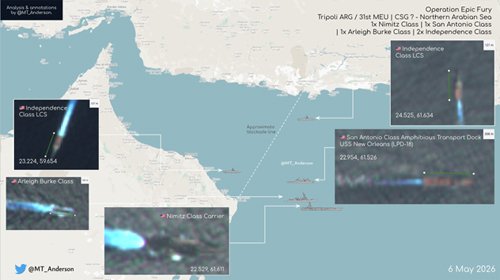
MT Anderson’s analysis of US Navy ship deployments in the Arabian Sea, May 6 (@MT_Anderson)
A separate tranche of imagery on May 7 also shows a busy lagoon at the Diego Garcia Naval Support Facility, with an Arleigh Burke destroyer present, and also the distinctive 193-meter MV Ocean Trader (IMO 9457218), which serves as a support base for the mounting of special force operations. The presence of MV Ocean Trader, carrying a key strategic capability, is normally an indicator and warning of a particular strategic focus and often of impending operations. An unidentified 130m long vessel is tied up at the jetty, possibly an Independence Class Littoral Combat Ship, or the cargo vessel Ship SLNC Star (IMO 9415325), which makes regular resupply runs from Singapore to Diego Garcia. Also present in the lagoon, as is normal, is one 291-meter long vessel, and hence either a Bob Hope or Watson Class replenishment ship of the Maritime Pre-positioning Ship Squadron 2 (MPSRON-2). On the South Ramp is a slightly smaller contingent of aircraft than is now normal: two US Navy P-8 surveillance aircraft, four KC-135 refuellers, and two large transport aircraft, but possibly with fighter aircraft in the four hangars.
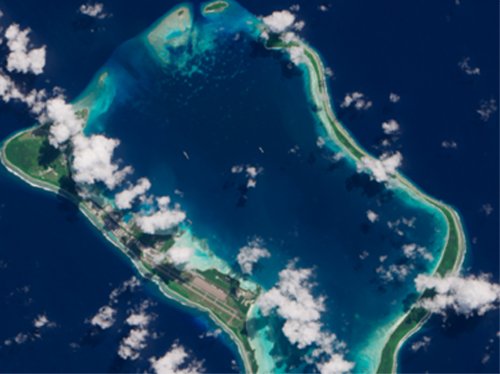
The Diego Garcia lagoon on May 7, with three ships at anchor and approximately eight aircraft on the South Ramp (Sentinel-2/CJRC)

that matters most
Get the latest maritime news delivered to your inbox daily.
There is no sign in the lagoon of any impounded dark fleet tanker. The WANA news agency, which is associated with a particular hardline faction of the IRGC intent on sabotaging any peace deal, claimed with no credibility on May 5 that two seized tankers were en route to Diego Garcia, whilst also admitting that the AIS systems of both these two ships were switched off. Without AIS information, it is difficult to understand how the WANA news agency would know where these two tankers were. In any case, they appear presently not to be in Diego Garcia, and are unlikely to arrive there while Lord Hermer remains the UK’s Attorney General, given his particular internationalist credentials.
Content Original Link:
" target="_blank">